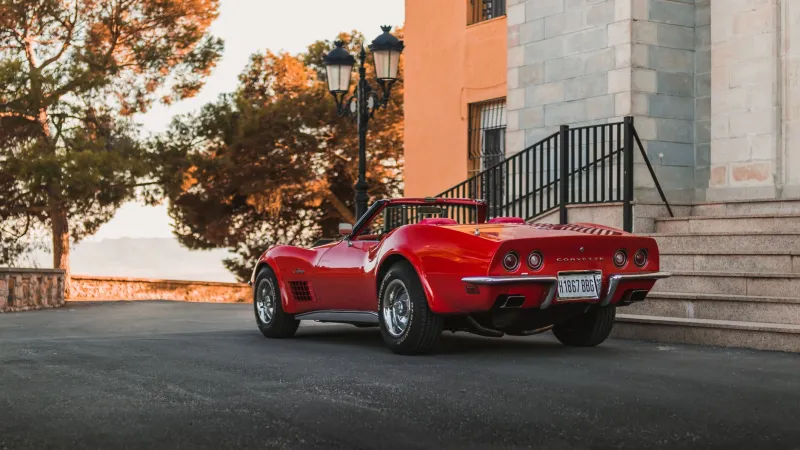
Rust, Grit, and Glory: Inside One Man's Mission to Resurrect a Forgotten 1972 Corvette
The first photograph Dave Kowalski texted his restoration guy showed a car that looked less like a Corvette and more like a cautionary tale. The fiberglass body panels had gone chalky and brittle in sections. The interior was a decade's worth of mouse habitat. The frame had surface rust creeping across it like a slow tide, and the numbers-matching LT1 V8 — one of the best small-blocks Chevrolet ever built — sat seized solid under a hood that hadn't opened since the Clinton administration.
"My buddy Mike just replied with a skull emoji," Dave laughs now, sitting in front of the finished car at a regional Corvette show outside Milwaukee. "He wasn't wrong."
But Dave Kowalski had driven past that barn in rural Waukesha County for three years before he finally knocked on the farmhouse door. Some cars just get into your head. This was one of them.
The Find
The backstory on the '72 was the kind you hear at swap meets and half-believe. The original owner — a machinist named Gerald Hoff — had bought the car new from a Chevy dealer in Racine, driven it hard through the early seventies, and then parked it in 1991 when a bad clutch job led to a repair estimate he didn't want to deal with. Gerald passed away in 2008. His family kept the property, kept paying taxes on the barn, and largely forgot the Corvette was in there until Dave showed up asking questions.
The car was a Targa Blue coupe, four-speed manual, with the LT1 350 cubic-inch V8 — the last year that engine was rated at 255 horsepower before emissions regulations started squeezing the life out of Detroit's performance cars. It was, underneath all the neglect, a genuinely significant car. Dave knew it. He paid a fair price, loaded it on a flatbed, and called Rick Sandoval at Midwest Classic Corvette Restoration in Kenosha the same afternoon.
"When it came off the trailer," Rick recalls, "my first thought was, this is going to be a long conversation about budget."
Assessing the Damage — and the Opportunity
The tear-down process took nearly three weeks and produced a list of problems that ran to two printed pages. The frame, while surface-rusted, proved structurally sound after sandblasting — a genuine relief that changed the project's financial calculus considerably. The fiberglass body panels were more complicated: two needed full replacement, three could be repaired with careful work, and the rest cleaned up better than anyone expected once the oxidation was addressed.
The engine was the centerpiece of every conversation. The LT1 is a numbers-matching unit, and Dave was adamant from day one that it would be rebuilt to factory spec rather than replaced or upgraded.
"Some guys would have dropped a crate LS in there and called it done," Rick says. "Dave wasn't interested in that. He wanted the car to be what it was supposed to be."
That decision — authenticity over convenience — defined every subsequent choice in the project. It also made sourcing significantly harder.
The Parts Hunt
Finding period-correct components for a 1972 Corvette requires a combination of specialized suppliers, patient forum-crawling, and occasional luck. Dave estimates he spent close to 200 hours over six months tracking down correct parts — everything from the correct date-coded carburetor to the proper interior trim pieces that matched the car's original build sheet, which he'd obtained through a GM Heritage Center documentation request.
The Corvettes West Co. classifieds and community network proved invaluable during this phase. "I found the correct Muncie four-speed through a forum contact in Arizona," Dave says. "Guy had three of them in his shop. We talked for an hour about the car before we even discussed price."
That kind of community knowledge — enthusiasts who've spent decades accumulating expertise on specific years and components — is something you can't replicate with a Google search. The '72 Corvette has a dedicated following precisely because it sits at the end of an era, and the people who care about these cars care deeply.
The most agonizing part of the sourcing process was the interior. The original seats were beyond saving, and correct-pattern upholstery in the right material and color required a specialty supplier in California who works exclusively with pre-1973 Corvettes. The lead time was fourteen weeks. Dave waited.
The Rebuild
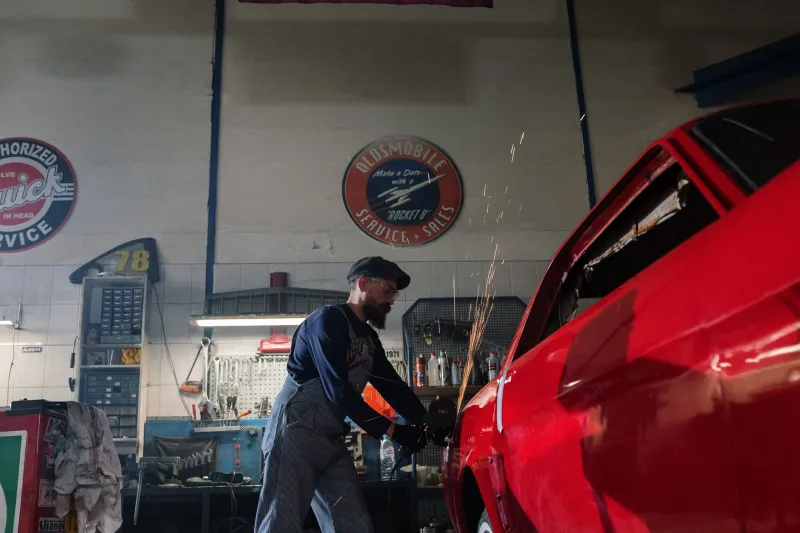
Rick Sandoval's shop logged over 400 hours on the project across eighteen months of active work. The LT1 was fully disassembled, inspected, and rebuilt to factory tolerances using a combination of new-old-stock components and carefully sourced reproductions where NOS wasn't available. The four-speed Muncie gearbox was similarly rebuilt.
The bodywork consumed more time than any other single element. Getting fiberglass repairs to disappear under paint is a craft, not a science, and Rick's body man — a guy named Tommy who's been working on fiberglass since the 1980s — spent weeks block-sanding and refining the repaired panels before anyone touched a spray gun.
The Targa Blue paint, mixed to match the original GM color code, went on in three stages. "Color matching on these older cars is never simple," Rick explains. "The factory paint had forty-plus years of UV exposure, so we had to be careful about how we approached the panels that didn't get repainted. You want the whole car to read as one color, not a patchwork."
The chrome brightwork — bumpers, door handles, trim pieces — went out to a plating shop in Illinois that specializes in restoration-quality work rather than show chrome. Dave had been clear: he wanted the car to look like a well-preserved original, not a trailer queen.
The Moment It Ran
The LT1 fired on the third crank attempt, settled into a lumpy idle, and then smoothed out as the engine warmed up. Dave was in the driver's seat. Rick was standing in the shop doorway with his arms crossed, watching.
"I didn't say anything for probably two minutes," Dave recalls. "I just sat there and listened to it."
The total cost of the project came in just under $48,000, including the purchase price of the car. That's a number that makes some people wince, and Dave doesn't pretend otherwise. But comparable restored '72 Corvette LT1 coupes with documented numbers-matching drivetrains have been selling in the $55,000–$70,000 range at auction, and the car's documented history and quality of restoration put it at the stronger end of that market.
More than the math, though, Dave talks about what the car represents. Gerald Hoff bought it new. It has a story. It was almost lost.
"There's a version of this where that car rots in that barn for another twenty years and nobody ever knows it existed," he says. "I couldn't let that happen."
What the Show Floor Felt Like
The regional meet outside Milwaukee was the car's public debut. Dave drove it there — forty-two miles on surface streets, first real road miles in over three decades. It drew a crowd within ten minutes of parking.
Old-timers walked around it slowly, bending down to look at details, nodding. A few asked questions about the restoration process. One man, probably in his seventies, stood next to it for a long time without saying anything, and when Dave asked if he'd owned one, the man said he'd sold his '72 in 1979 to pay for a down payment on a house and had regretted it ever since.
That's the thing about bringing a car like this back. It doesn't just belong to the person who restored it.